Monday, June 22, 2009

Declaration of Health Data Rights

A great thing is being announced as I write this: a declaration of health data rights. On the surface it's simple and seems not controversial:


A Declaration of Health Data Rights


In an era when technology is allowing personal health information to be more easily stored, updated, accessed and exchanged, the following rights should be self-evident and inalienable. We the people:
  1. Have the right to our own health data

  2. Have the right to know the source of each health data element

  3. Have the right to take possession of a complete copy of our individual health data, without delay, at minimal or no cost; if data exist in computable form, they must be made available in that form

  4. Have the right to share our health data with others as we see fit

These principles express basic human rights as well as essential elements of health care that is participatory, appropriate and in the interests of each patient. No law or policy should abridge these rights.


Seems obvious, right? In reality, it can be difficult to get your data, especially if you want it promptly because you're in trouble.

Current regulations require that you be given your records on request, but they can take up to two months to do so, and they can charge various amounts. One woman I know, whose husband died of Stage IV kidney cancer last week, was charged 73 cents a page (the records contained numerous mistakes and unfilled orders), and in Texas they can charge $37 for the first ten pages. If you've ever been under financial stress from medical hardship, you know what a grotesque thing that is to do to a patient's family.

On top of that, in some states (e.g. Virginia), laws prevent you from getting the results of your own lab tests; the law says the data can only be given to the doctor who ordered it. (I can only guess who wrote THAT law.) In a timely coincidence, today this article appeared in Archives of Internal Medicine: Patients Often Not Told About Abnormal Test Results, including this:
The failure of doctors and medical facilities to follow-up and give people test results is "relatively common," the researchers wrote, even when the results are abnormal and potentially troublesome, and affects one of every 14 tests."

All of this reflects an assumption, unspoken or not, that you have no real right to your data, and you're putting them out by requesting it. I disagree.

In endorsing this declaration, tonight I wrote:

These rights are as inalienable as the right to life itself.

Whose life depends on the data's accuracy, its availability?

Whose data is it, anyway?

For more information including the list of endorsing organizations, see HealthDataRights.org. To endorse it yourself, click the big orange "endorse this" button or just click here. To see the 800+ endorsements so far, click here.

Wednesday, June 17, 2009

Christensen: "The traditional general hospital is not a viable business model"

Last week I was fortunate to meet Clay Christensen at a CEO Roundtable breakfast at my hospital, Beth Israel Deaconess. I didn't get to ask the questions that some of you proposed on my previous post, but that will come later. For now, I want to share something that I wrote ad hoc this morning.

Paul Levy, CEO of the hospital, says on his blog that he's been thinking a lot about something Christensen said: "The traditional general hospital is not a viable business model." He pointed out that these hospitals only survive through philanthropy and government funding, i.e. taxes. As you might imagine, this could be problematic to a hospital CEO :-), and Paul expresses his thoughts well, as usual.

He ends by talking about a key concept in the Obama administration's thinking about healthcare reform: "Accountable Care Organizations," or ACOs. There is a concern that this good concept, modeled on the great success of transformed organizations like Kaiser-Permanente, Mayo, and Geisinger, could be perversely applied to untransformed hospitals. I don't know much about the ACO issue, but something about the discussion struck me, and I posted this as a [long] comment. Here it is, with a little editing to touch it up.

----------

I'm going to (yet again) try to express something in an area where I know I'm way over my head.

Isn't there an irony in "accountable care organization"? In business (the kind of business Christensen has studied) leaders know they're accountable to the market because if they don't improve their offerings, someone else might. It may be with the occasional rare disruptive innovation or with the usual non-disruptive improvements, but if you snooze you lose; if you get complacent you can get blind-sided; etc etc etc.

To my naive eyes, this form of accountability (improve services or die) seems absent from healthcare delivery systems largely because it's so hard to enter this market, so any dominator can be as bloated as it wants, and (whether they realize it or not) the managers end up with an attitude of "recipients [consumers] be damned, there's nothing we can do about it."

It's basically the same thing GM executives told Congress in the 1960s. "It's simply not possible to build a better car. We should know; we're the experts."

The thing is, this isn't sustainable: it appears that collapse is coming. PCPCC has been saying for years that HC costs have reached a "game over" scenario (growing faster than employers' earnings), and I recently heard that through May 31, for the first time in history enrollment in US health plans is DOWN 5% year to date.

Given that this is an industry that generally has no experience at significantly tightening its belt while delivering the same result, there's going to be a lot of pain as the collapse begins. Pain in the industry and pain among the consumers who can't get care.

The Globe op-ed page the other day had a block with a few one-line quotes. One guy said "I pay for what prescriptions I can, and beyond that I trust in God." Great work, healthcare industry. Thanks.

Anyway, yeah, I love Clay's message, because it's the first perspective I've seen that (in my interpretation) comes down to "Look, you guys, whether you like it or not, your leviathan selves are headed for a cliff. It's up to you whether you want to take action before or after that happens."

In a recent post on e-patients.net, ACOR founder Gilles Frydman (who knows a few things about what patients do when their needs aren't being met) wrote Will the Great Recession Create Millions of e-Patients? As people stay unemployed (and thus uninsured) long enough that life's illnesses arise, they'll be fending for themselves. They (we) will band together and do what we need, to help each other.

And that brings me to the one thing I think is missing from Clay's prescription. The third part of his mix is patient communities for chronic conditions such as diabetes. What he doesn't predict is something that already exists: patient communities for everything else.

One example is ACOR (communities of cancer patients), where patients often share information that's less well known, sometimes even unknown to their physicians. Another is PatientsLikeMe, where patients band together because the establishment is out of answers for their condition. And mark my words, another will be patients who've been priced out of the market and, more or less desperately, need care for themselves, their kids, their parents.

Christensen talks about the inexorable shift of value from decentralized to centralized and back out to decentralized. What he hasn't mentioned yet is the value that's being generated in the ecosystem completely off the grid. When consumers start to get what they need without even getting in the game, an industry's foundation crumbles.

Because, after all, what drives disruption in the first place (what drives all innovation) is whether consumers' needs are being met efficiently. Increasingly in this game, the needs aren't being met at all.

Saturday, June 6, 2009

Let's discuss Clay Christensen's "Innovator's Prescription"

I want to start a discussion among people who've read, or are reading, Clay Christenson's Innovator's Prescription.

Harvard Business School professor Clayton Christensen is, arguably, the most important observer of what makes some technical changes take off and others not. He's the one who created the concept of "disruptive innovation."

It's important to understand that "disruptive" in this sense is not about being socially disturbing or rebellious, it's about developing a new solution that comes from a new direction, rather than being a continuation of the "same-old same-old." The Wikipedia article has good examples of what is and isn't disruptive, in this sense.

In my own career, I witnessed the disruption of the typesetting industry (where I worked) by desktop publishing, which let consumers get what they needed without going through conventional typesetters. To be sure, it was painful to watch my industry die, but die it did – because customers wanted more than we were giving them in service and value.

Because disruption generally rejects the establishment, it's often accompanied by denial on the part of the dominant technology; in my case, we in typesetting said "Our craft is full of skill and knowledge; it takes years to get good at it. Desktop publishing is a toy. It has none of our professional features." But it turned out that consumers were happy to make do with something they could do themselves at a fraction of the cost.

And – and this is pivotal – as the use of desktop publishing spread, its features grew: it became not just a toy. We in typesetting watched the list of our advantages shrink. It was an extreme case, because our entire industry pretty much disappeared in about five years.


Christensen introduced the disruptive concept in 1995 after studying the rapid evolution of disk drive technology. He's since applied it to many industries, and it's been said that entire new national economies have used it (successfully) to plan growth strategies.

But he says his hardest project "by a full order of magnitude" has been to understand healthcare. He's been working on it for ten years – most of the time since he developed the concept – and his healthcare book was just published this February. Importantly, he's not just a techie geek who rejects the medical establishment. He worked closely with some serious doctors, who concur with his conclusions.

But not everyone does agree. One doctor I highly respect says Christensen "nailed the diagnosis but blew the prescription."

I want to discuss it here because I'm someone who's not mired in the industry, but who HAS seen industries get disrupted, and it seems screamingly obvious to me that US healthcare is ripe for disruption. Although its services are life-saving (I'm an example of that), the work is overpriced, consumer satisfaction is very low, people generally can't get what they want when they want it, yet prices keep going up, to the point where some people and some employers are just saying "Screw it" and going without. (Recent statistics have pointed to increases in both; I'm too tired to dig out the links, but it's real, especially for small businesses and all their employees. The healthcare system is pricing itself out of a job.)

Dr. Alan Greene, president of the Society for Participatory Medicine, often mentions in his speeches that healthcare is a bubble, not unlike the internet bubble that popped a while ago. He talks about Disruption and the healthcare bubble. That's an excellent little post – please read it if you want a deeper understanding of what' s up.

I'm only partway through the book, and my free time for reading has been unpleasantly low, so I'd like to hear the thoughts of those who've read it। If you have, please comment.

Quick start: see the reader reviews on Amazon.

Sequel: Christensen: "The general hospital is not a sustainable business model"

"Give us our data": My talk at the NeHC board meeting 6/2/09

Cross-posted from the e-patient blog.

Last Tuesday, June 2, I was on a consumer panel at a board meeting of the National eHealth Collaborative. This is a heady group to be addressing; as this press release says, nine of these people are on the advisory committees that are working directly with David Blumenthal, Obama's National Coordinator for Health IT, to set policy and standards.

My deepest, sincerest thanks to Steve Findlay of Consumers Union, who invited e-patients.net to be on this panel. What a radical idea: have a consumer on a consumer panel! It's so good to see the skies opening in this way.

The topic was whether "consumer pull" would encourage healthcare providers to adopt electronic medical record systems (EMRs). (Like, if you and I keep asking our doctors and hospitals to let us see our data online, will they be more likely to get off their butts and GET our data online??)

All I can say is, if I have anything to do with it, consumers (that's you) will be clamoring to see their medical records, both to check their accuracy and for the reason I sent my data to Google Health in the first place: to get involved in their care, to be responsible, to participate.

Go thou into the wilderness and clamor for access!

Here are the slides I used, with a few more added to make it a self-running presentation. Some of the text is small, so take it to full screen:

The panel was videotaped. (It's not available in embeddable format yet.) My portion starts at 34:09.

Video of consumer panel at NeHC board, June 2, 2009

The other panelists were phenomenal; I learned a ton from their expert observations. Some of it was over my head until I listened a couple of times; they have years of experience in these policy discussions. All I know is, I want us to have access to our own damn data. :–)

By the way, a big thank-you to SlideBoom.com, the free service that converted my slides for posting here, including my animations and slide transitions, which cause fits for most such services. Good tool!

Wednesday, May 20, 2009

IBM to announce results of Medical Home project

On Tuesday I was invited onto a blogger conference call hosted by IBM to discuss the Medical Home concept. I was immensely happy that IBM had the vision to invite a plain old ordinary patient to be on the call. Good for them!

As longtime readers know, I've written about the medical home concept several times. It's about the fact that so many people lack a plain old ordinary doctor's office where they KNOW you – a medical "home," as it were. (Or, as they say on Cheers, "Where everybody knows your name.")

Everyone else on the call was "in the business," and as it happens, the slides were far more "in the business-y" than I would have preferred. (They're posted below.) To get a concept like this into the skulls of the Very Smart Important People in government, it seems they have to talk in abstractions and Big Principles.

Suggestion: How about also including some street reality common sense facts? Like, people who have a medical home are half as likely to have a heart attack! That statistic was mentioned (in passing!) by IBM's Dr. Paul Grundy (who's become something of a buddy of mine) at the start of the call, but wasn't considered relevant enough to put in the slides!

See, IBM employs a LOT of people so they have a LOT of data about what works. 6-8% of their insured employees are in a Medical Home plan, and that's the result IBM has seen.

Wouldn't you like to be in a plan with that kind of results? Doesn't cost anymore, either. So what the heck is everyone else thinking, and what are they waiting for?

Hey IBM ... Since I'm officially a patient advisor to PCPCC, here's some advice :-)

  • Let's also start some grass-roots demand for the medical home concept. (I'll start, by telling people here.)

  • Somebody remember the 7/30 rule of slides: no more than 7 lines of 30 characters. More than that doesn't get read. :-)
Thanks for inviting a patient – I want to help this cause win.

Here are the slides:


Tuesday, May 12, 2009

BIDMC's Dr. Andrew Wagner on surgery options for kidney cancer patients

Dr. Andrew Wagner, the surgeon who brilliantly removed my kidney (which had tumors sticking out on two sides), kindly agreed to discuss the options available to kidney cancer patients.

I'm putting the audio here in two versions. First, here's my attempt using Utterli, a new website that lets you upload any kind of audio.


Here's another copy from the BlogTalkRadio web site where I recorded it:

Dr. Wagner is co-chairman of the renal tumor program at my hospital. A five minute video about that program, and how it brought me back from the brink, is here. The program's web site, with contact info for the doctors, is at www.bidmc.org/renaltumor.

Update 12/29/09: In response to a discussion in my patient group on ACOR.org, I asked Dr. Wagner for some additional thoughts. His response is here.


Next in this series – June 2009: Dr. David McDermott discusses medical treatment options.

Sunday, April 26, 2009

Rally in support of those imprisoned for expression

A group of bloggers is holding a blog rally this week to support this cause. I'm joining in. The blog post where this started is here: Bloggers Are Dying.


The Universal Declaration of Human Rights states, "Everyone has the right to freedom of opinion and expression; this right includes freedom to hold opinions without interference, and impart information and ideas through any media regardless of frontiers."

Journalist Roxana Saberi has been incarcerated in Tehran's Evin Prison, where she is spending her birthday on a hunger strike. Around the world, people continue to face similar violations of their rights to freedom of expression, free speech, and a free press. Let's show the international community that we won't be silenced by intimidation and tyranny - that we won't stop believing in and fighting for these rights.

Freedom of the press is not a luxury. It lies at the heart of making this world healthier and more just. People without a voice and without a clear line of sight into the things that would threaten or corrupt their societies cannot hope for equitable growth and meaningful change.

A group of bloggers is holding a blog rally in support of journalists, bloggers, students, and writers who have dared to express their thoughts freely and have been imprisoned, abused, or killed.

Please consider "wearing" a blue ribbon online this week on your blogs, websites, and facebook / myspace / twitter pages, and invite others to do the same. Get the discussion going, and keep it going!

Saturday, April 11, 2009

How Bacteria Communicate (fantastic new TED talk)

In case you haven't heard yet, TED (description) is an annual conference with 50 incredible talks, in 18 minutes, on a vast range of topics. They're usually amazing, and sometimes mind-blowing. Afterward they're collected on the TED Talks web site.

This one was just posted this week. Bonnie Bassler's team of students at Princeton has found that bacteria, those little single-celled things, communicate with each other. The implications are, to say the least, stimulating.


My favorite other TED talks:
A Neuroanatomist Witnesses Her Own Stroke (posted here a year ago)
Hans Rosling and his incredible software for visualizing data (2006)
Eva Vertes, 19 year old on her new approach to cancer

Tuesday, April 7, 2009

Blog Rally to Help the Boston Globe

All of us in Boston read last weekend about the threat of possible closure faced by the Boston Globe. A number of Boston-based bloggers who care about the continued existence of the Globe have banded together in conducting a blog rally. We are simultaneously posting this paragraph to solicit your ideas of steps the Globe could take to improve its financial picture.

"We view the Globe as an important community resource, and we think that lots of people in the region agree and might have creative ideas that might help in this situation. So, here's your chance. Please don't write with nasty comments and sarcasm: Use this forum for thoughtful and interesting steps you would recommend to the management that would improve readership, enhance the Globe's community presence, and make money. Who knows, someone here might come up with an idea that will work, or at least help. Thank you."

Saturday, April 4, 2009

Imagine someone had been managing your data, and then you looked.

This is cross-posted from the e-patient blog. I wrote it as my own somewhat astonished observations, but I had no idea how much uproar it would create. The commenters added a lot, so if you're interested in this subject, go there and look.

This is a complex post, so don’t jump to any conclusions.

Two weeks ago (gad, was it that long?) I asked you to think about something for a few days:

Imagine that for all your life, and your parents’ lives, your money had been managed by other people who had extensive training and licensing. Imagine that all your records were in their possession, and you could occasionally see parts of them, but you just figured the pros had it under control.

Imagine that you knew you weren’t a financial planner but you wanted to take as much responsibility as you could – to participate. Imagine that some money managers (not all, but many) attacked people who wanted to make their own decisions, saying “Who’s the financial planner here?”

Then imagine that one day you were allowed to see the records, and you found out there were a whole lot of errors, and the people carefully guarding your data were not as on top of things as everyone thought.
Two weeks before that post, I’d had a personal breakthough in my thinking. For a year I’d been a rabid enemy of Google Health, but now I said: I’m putting my data in Google and HealthVault: “I’m concluding that we can do more good by aggregating our data into large, anonymized databanks that smart software can analyze to look for patterns. Early detection means early intervention means fewer crises.”

And I observed that the power of Web 2.0 “mash-ups” …
…lets people create software gadgets without knowing how they’ll be used, it lets people build tools that use data without knowing where the data will come from, and it lets people build big new systems just by assembling them out of “software Legos.”
So, I said, “I’m in.” I decided to punch the big red button and copy my personal health data into Google Health.

What happened is the result of PatientSite's "version 1" implementation, not their eventual full implementation, of the interface. To my knowledge, zero or one other hospitals have any interface at all, and as I'll say later, I'm not even sure how much of the Google Health side of the connection is complete. Nonetheless, what I learned about my own data was quite informative, and quite surprising.

(I've discussed what follows with hospital staff; this isn't gossip behind anyone's back. IMO, empowered people don't gossip, they communicate clearly and directly with the people involved.)


When Google Health launched last May, my hospital’s CIO blog said “we have enhanced our hospital and ambulatory systems such that a patient, with their consent and control, can upload their BIDMC records to Google Health in a few keystrokes. There is no need to manually enter this health data into Google's personal health record, unlike earlier PHRs from Dr. Koop, HealthCentral and Revolution Health.”

So I went into my patient portal, PatientSite, and clicked the button to do it. I checked the boxes for all the options and clicked Upload. It was pretty quick.

But WTF? An alarm: "! Requires immediate attention"
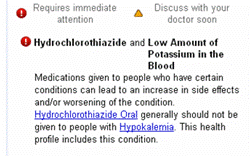
 

HCTz interaction alarmOkay, yes, HCTz is my blood pressure medication.

But low potassium? That was true when I was hospitalized two years ago, not now. What’s going on?


Then I saw the list of “conditions” it told Google I have. Here's a partial screen grab:
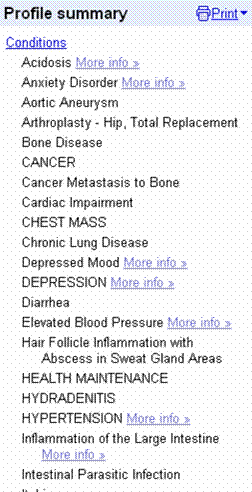
Google Health conditions listAnd here's the complete list that PatientSite transmitted: (spoiler alert; this stuff is biological)

 Acidosis
Anxiety Disorder
Aortic Aneurysm
Arthroplasty - Hip, Total Replacemt
Bone Disease
CANCER
Cancer Metastasis to Bone
Cardiac Impairment
CHEST MASS
Chronic Lung Disease
Depressed Mood
DEPRESSION
Diarrhea
Elevated Blood Pressure
Hair Follicle Inflammation w Abscess in Sweat Gland Areas
HEALTH MAINTENANCE
HYDRADENITIS
HYPERTENSION
Intestinal Parasitic Infection
Kidney Problems Causing a Decreased Amount of Urine to be Passed
Lightheaded
Low Amount of Calcium in the Blood
Low Amount of Potassium in the Blood
Malignant Neoplastic Disease
Migraine Headache
MIGRAINES
Nausea and Vomiting Nephrosis
PSYCH
Rash
Spread of Cancer to Brain or Spinal Cord
Swollen Lymph Nodes
Yes, ladies and germs, it transmitted everything I’ve ever had. With almost no dates attached. (It did have the correct date for my very first visit, and for Chest Mass, the x-ray that first found the undiagnosed lesion. But the date for CANCER, the big one, was 5/25/07 – four months after the diagnosis. And no other line item had any date. For instance, the "anxiety" diagnosis was when I was puking my guts out during my cancer treatment. I got medicated for that, justified by the intelligent observation (diagnosis) that I was anxious. But you wouldn't know that from looking at this.)

See how some of the listed conditions have links for More Info? Optical migraine imageLet’s see, I was diagnosed with optical migraine, an odd symptom that produces a little dazzling pattern in one eye occasionally. (See illustration; it happened for a brief period and stopped.) (I diagnosed myself, actually, by researching my symptoms and finding this illustrated site. That’s what e-patients do; it saves time in the doctor’s office… I brought a printout, with a dated list of episodes.) But optical migraine is not the impression you’d get from reading my Conditions list – in fact during my cancer workup one resident said “But you have headaches, right?” “No,” I said – “optical migraines, but without pain.”

So for that item in the conditions list, I clicked More Info. I didn’t get more info (i.e. accurate info) about my diagnosis, just Google’s encyclopedia-style article about migraines in general. (An optical migraine has little in common with migraines in general.)

The really fun stuff, though, is that some of the conditions transmitted are things I’ve never had: aortic aneurysm and mets to the brain or spine.

So what the heck??


I’ve been discussing this with the docs in the back room here, and they quickly figured out what was going on before I confirmed it: the system transmitted insurance billing codes to Google Health, not doctors’ diagnoses. And as those in the know are well aware, in our system today, insurance billing codes bear no resemblance to reality.

(I don’t want to get into the whole thing right now, but basically if a doc needs to bill insurance for something and the list of billing codes doesn’t happen to include exactly what your condition is, they cram it into something else so the stupid system will accept it.) (And, btw, everyone in the business is apparently accustomed to the system being stupid, so it’s no surprise that nobody can tell whether things are making any sense: nobody counts on the data to be meaningful in the first place.)

It was around this time that I commented on Ted Eytan’s blog, “when you’re exporting to a new system, the rule is, Garbage Out, Garbage In. (Hint: visibility into the data in your old system may leave you aghast.)”

We could (and will someday) have a nice big discussion about why the hell the most expensive healthcare system in the world (America’s) STILL doesn’t have an accurate data model, but that’s not my point. We'll get to that.


And now we get to why I said, at the outset, don’t jump to conclusions. I’m mildly bitching about PatientSite, but that alone wouldn’t justify staying up to 3 in the morning writing a 2800 word post; that one system isn't a big deal for e-patients everywhere. (And besides, although PatientSite is old and clunky, a 1999 system if I ever saw one, it beats what most hospitals offer, and it did the job very well for me during my illness. And this is just version 1 of the interface; the current folly is not a permanent situation.)

The BIG question is, do you know what’s in your medical record? And THAT is a question worth answering. For every one of you.

See, every time I speak at a conference I point out that my 12/6/2003 x-ray identified me as a 53 year old woman. I admit I have the man-boob thing going on, but not THAT much. And here’s the next thing: it took me months to get that error corrected, because nobody’s in the habit of actually fixing errors.

Think about THAT. I mean, some EMR pontificators are saying “Online data in the hospital won’t do any good at the scene of a car crash.” Well, GOOD: you think I’d want the EMTs to think I have an aneurysm, anxiety, migraines and brain mets?? Yet if I hadn’t punched that button, I never would have known my data in the system was erroneous.

And this isn’t just academic: remember the Minnesota kidney cancer tragedy just a year ago, which arose at least partly out of an error that ended up in the hospital’s EMR system. Their patient portal allowed patients and family to view some radiology reports, but not the one that contained the fateful error.


The punch line came when I got over my surprise about what had been transmitted, and realized what had not: my history. Weight, BP, and lab data were all still in PatientSite, and not in Google Health.

So I went back and looked at the boxes I’d checked for what data to send, and son of a gun, there were only three boxes: diagnoses, medications, and allergies. Nothing about lab data, nothing about vital signs. (So much for “no need to manually enter this health data into Google's personal health record.”)

And of the three things it did transmit:
  • what they transmitted for diagnoses was actually billing codes
  • the one item of medication data they sent was correct, but it was only my current BP med. (Which, btw, Google Health said had an urgent conflict with my two-years-ago potassium condition, which had been sent without a date). It sent no medication history, not even the fact that I'd had four weeks of high dosage Interleukin-2, which just MIGHT be useful to have in my personal health record, eh?
  • the allergies data did NOT include the one thing I must not ever, ever violate: no steroids ever again (e.g. cortisone) (they suppress the immune system), because it’ll interfere with the immune treatment that saved my life and is still active within me. (I am well, but my type of cancer normally recurs.)
In other words, the data that arrived in Google Health was essentially unusable.

And now I’m seeing why, on every visit, they make me re-state all my current medications and allergies: maybe they know the data in their system might not be reliable. Hey wait, a new article in the Archives of Internal Medicine (co-authored by our own Danny Sands, my very own primary) says Clinicians override most medication alerts. Could it be they've been through this exercise themselves, and they consider the data unreliable? (Or do they just not trust computers?) (Hey Pew Internet, wanna check for generational differences?)

Who knows, perhaps the resident in the migraine story has learned early on that the data in his system is not to be taken at face value – I don't know.

In any case, my hospital is very proactive and empowering to staff about root cause analysis for failures, with its "SPIRIT" program, and they’ll add any process or form that can catch potential errors. That’s good.

But wait: On numerous visits, I’ve restated on those forms “no steroids.” But evidently what I write on the forms never gets entered into the system. Hm.


I work with data in my day job. (I do marketing analytics for a software company. We import and export data all the time.) I understand what it takes to make sure you’ve got clean data, and make sure the data models line up on both sides of a transfer. I know what it’s like to look at a transfer gone bad, and hunt down where the errors arose, so they don’t happen again. And I’m fairly good at sniffing out how something went wobbly.

And you know what I suspect? I suspect processes for data integrity in healthcare are largely absent, by ordinary business standards. I suspect there are few, if any, processes in place to prevent wrong data from entering the system, or tracking down the cause when things do go awry.

And here’s the real kicker: my hospital is one of the more advanced in the US in the use of electronic medical records. So I suspect that most healthcare institutions don’t even know what it means to have processes in place to ensure that data doesn’t get screwed up in the system, or if it does, to trace how it happened.

Consider the article in Fast Company last fall, about an innovative program at Geisinger. Anecdotally, it ended with this chiller:
… a list of everybody that accessed the medical record from the time he was seen in the clinic to two weeks post-op.'There were 113 people listed -- and every one had an appropriate reason to be in that chart. It shocked all of us. We all knew this was a team sport, but to recognize it was that big a team, every one of whom is empowered to screw it up -- that makes me toss and turn in my sleep."
In my day job, our sales and marketing system (Salesforce.com) has very granular authorizations for who can change what, and we can switch on a feature (at no extra cost) to track every change that’s made on any data field. Why? Because in some business situations it’s important to know where errors arose – an error might cause business damage, or an employee might sue over a missed quota.

So I’m thinking, why on earth don’t medical records systems have these protections? If a popular-priced sales management system has audit traces, to prevent an occasional lawsuit over a sales rep’s missed commission, why isn’t this a standard feature in high-priced medical records systems?

In any case, in the several weeks since these discoveries started, as far as I know they haven’t figured out how my wrong data got in there. And without knowing how the wrong data got in, there’s not a prayer of identifying what process failed.


BUT AS I SAID, this is not about my hospital; a problem at my hospital affects only one scrillionth of patients in the US, not to mention the rest of the world And please don’t blame my hospital’s CIO; I think what he wrote about the Google Health interface was overzealous, but I believe he’s a good man, committed to helping us own our own data (his work on the Google Health advisory board was unpaid), and this post isn’t about him: as far as I know, this hospital is farther along than anyone else: hardly anyone else has implemented a Google Health interface. (Perhaps for good reason.)

Nor is this a slam on Google Health. I haven't probed yet into whether there are limitations in what it does; might be fine, might not. Heck, neither PatientSite nor I have put any good data into it yet. (And I haven't even touched HealthVault.) None of that is my point.

Rather, my point is about the data that was already in my PHR, uninspected. For that, let’s return to my previous post:
Then imagine that one day you were allowed to see the records, and you found out there were a whole lot of errors, and the people carefully guarding your data were not as on top of things as everyone thought.
In my day job, when we discover that a data set has not been well managed, we have to make a decision: do we go back and clean up the data (which takes time and money), or do we decide to just start “living clean” from now on?

My point, my advice to e-patients, is:
  • Find out what’s in your medical record. What’s in your wallet, medically speaking? Better find out, and correct what’s wrong.
  • Get started, manually, moving your data into Google Health, HealthVault, or some such system. I’ve heard there are similar PHR systems (personal health records), not free but modestly priced, that can reportedly make this easier. I’m sure their friends will show up here in the comments. (Feel free to post product info links in the comments, everyone.)
  • Let’s start working, now, on a reliable interoperable data model. I know the policy wonks are going to scream “Not possible!” and I know there are lots of good reasons why it’s impossibly complex. But y’know what else? I’ve talked to enough e-patients to be confident that we patients want working, interoperable data. And if you-all in the vendor community can’t work it out, we will start growing one. It won’t be as sophisticated as yours, but as with all disruptive technologies, it will be what we want. And we’ll add features to ours, faster than you can hold meetings to discuss us.
          I have to say, while researching this post I was quite surprised at how very, very far the industry has to go before reaching a viable universal data model. New standards are in development, but I'm certain that it will take years and years and gazillions of dollars before any of that is a reality. (What, like costs aren't high enough already?) In the meantime, your data is probably not going to flow very easily from system to system. Far, far harder than (for instance) downloading your data to Quicken from different credit card companies and banks.
          (Wizards and geeks refer to this "flow" issue as "data liquidity." We'll talk about that in the future.)
  • Let’s start working, now, on an open source EMR/PHR system. The open source community creates functionality faster, and more bug-free, than commercial vendors do – and nobody can latch onto proprietary data in such systems to milk more margin out of us... because it ain't proprietary.

          The great limitation of open source is that it’s generally not well funded. But you know what? Every person in America (including software engineers) is motivated to have good reliable healthcare systems, and I assert that the industry ain’t getting’ it done on their own. As I said in my Thousand Points of Pain post (cross-posted on IBM’s Smarter Planet blog as A business thinker asks, what will it take to get traction?), it’s fine with me if industry vendors come along too – but I would not stake my life on their moving fast enough for my needs. Or your mother's.
Want a case study with real consequences? Recall what happened last year to famed Linux guru Doc Searls when he couldn’t read his own scan data, because good cross-platform image viewing tools weren’t available. (His prescription: the patient should be the platform and “the point of integration.”)

Well, okay, so Doc was a year ahead of me. I'm catching on. This illustrates why I think people from outside the profession may be our greatest asset in building what patients really need: patients tend to build what they want. And we who work with data all day know that these problems are not unsolvable.


My bottom line: I think we ought to get our data into secure online systems, and we shouldn’t expect it to happen with the push of a button. It’ll take work. So let’s get to work.

You know the work will be good for you, and heaven only knows what you’ll learn in the process. You’ll certainly end up more aware of your health data than when you started. And that’s a good thing.